
What are phakic lenses?
A phakic lens is an implant placed inside the eye while preserving the natural crystalline lens. The goal is to correct refractive error without removing the natural lens and without laser reshaping of the cornea.
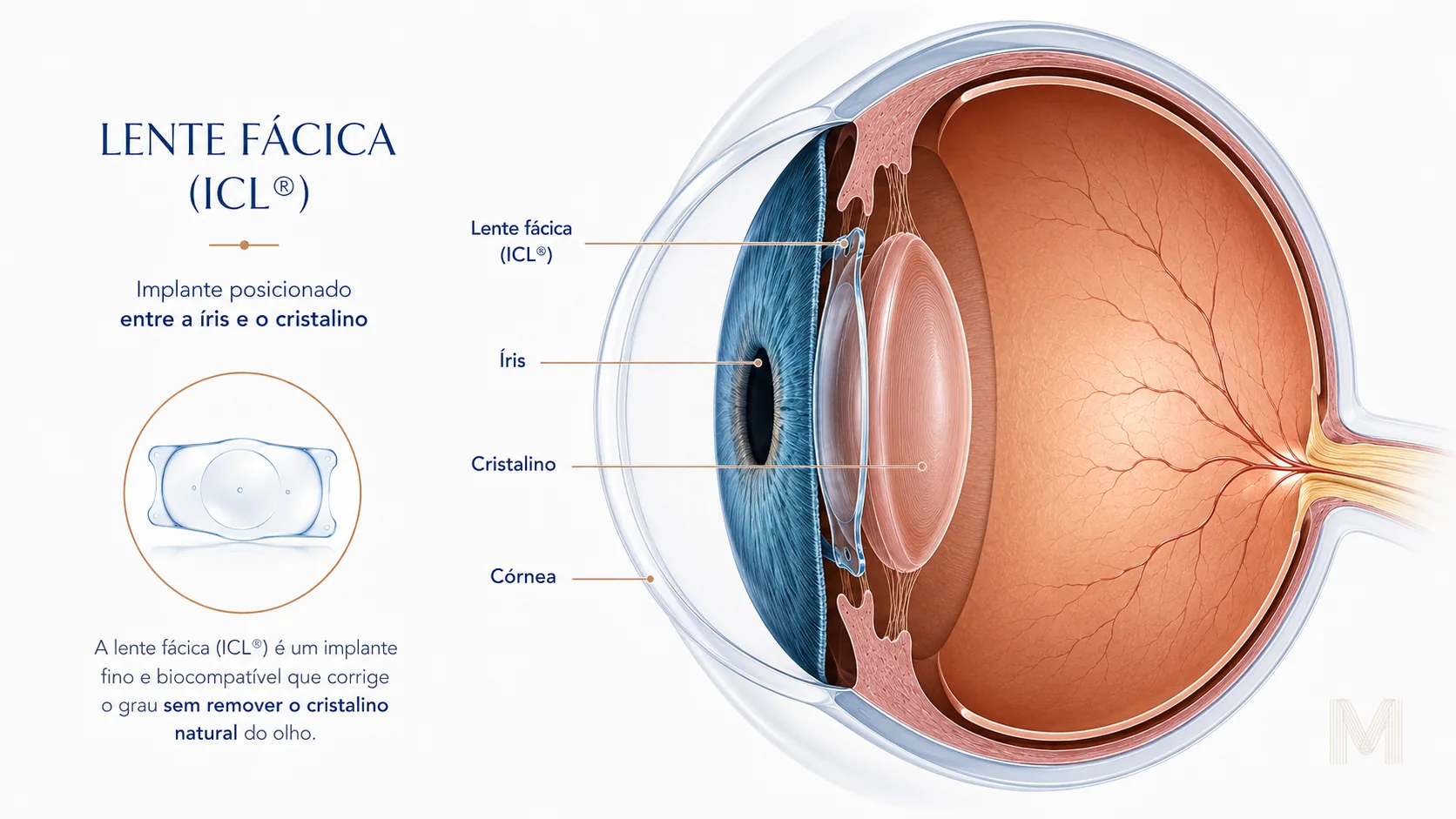
The lens is positioned inside the eye in selected patients who meet anatomical and safety criteria.
When can they be considered?
They may be an option for patients with higher degrees, thin or suspicious corneas, or cases in which PRK or LASIK is not recommended. Even candidates for PRK or LASIK may choose a phakic lens when they meet criteria and prefer a reversible option that does not alter corneal anatomy.
Laser or ICL: general comparison
The choice between laser surgery and a phakic lens depends on tests and eye anatomy. The table below summarizes situations often discussed during the evaluation.
| Situation | Laser surgery | ICL/phakic lens |
|---|---|---|
| Thin cornea | May limit indication | May be an alternative in selected cases |
| High degree | May require more tissue removal | Preserves corneal structure |
| Dry eye | May influence symptoms | May be considered depending on the case |
| Reversibility | Not reversible | The lens may be removed or exchanged in specific situations |
| Type of surgery | Corneal procedure | Intraocular surgery, with its own risks |
The choice depends on exams, ocular anatomy, degree, age, visual routine and individualized evaluation.
Important examinations
- Anterior chamber depth and internal eye measurements
- Corneal topography and tomography
- Endothelial cell count
- Retinal evaluation
- Review of prescription stability and expectations
How the procedure works
The procedure is performed in a surgical environment. The implant is placed inside the eye through a small incision, and follow-up is needed to monitor pressure, inflammation and lens position.
Risks and points of attention
As with any intraocular procedure, risks may include inflammation, pressure changes, cataract formation, endothelial cell loss, infection and need for additional procedures. These risks must be discussed individually.
Realistic expectations
Phakic lenses may reduce dependence on glasses or contact lenses, but they do not eliminate the need for medical follow-up and do not guarantee perfect vision.
Quick questions
Is ICL better than laser?
Not necessarily. ICL may be an alternative in selected cases, but the best option depends on cornea, degree, internal eye anatomy and individual risks.
Is a phakic lens reversible?
In specific situations, the lens may be removed or exchanged. Even so, it is intraocular surgery and requires careful indication.
Does ICL require follow-up?
Yes. Follow-up monitors eye pressure, lens position, inflammation, corneal endothelium and long-term eye health.
Evaluate whether ICL makes sense for your case
Dr. Marcelo can compare laser surgery, phakic lenses and non-surgical options after a complete evaluation.